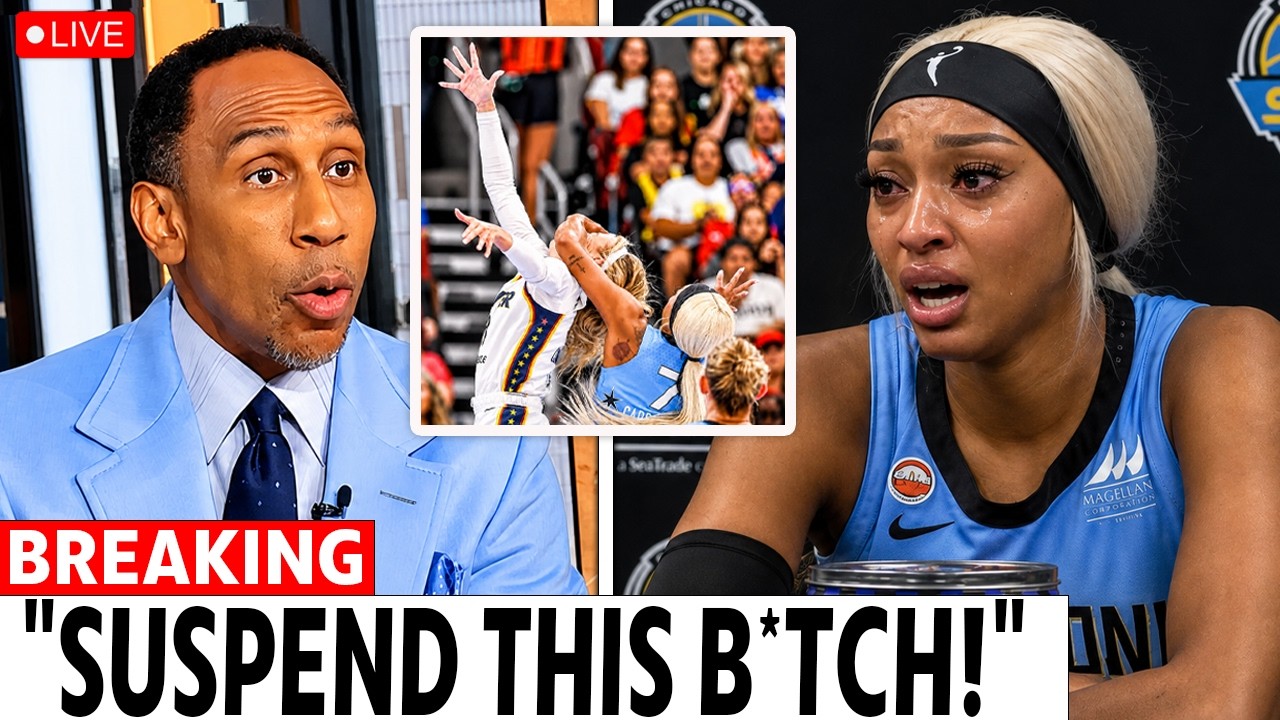
The Caitlin Clark physicality debate has exploded again.
Stephen A. Smith is furious.
DiJonai Carrington is back at the center of controversy.
And once again, millions of basketball fans are asking whether the WNBA has allowed ordinary physical defense to cross into something much uglier.
But there is one important twist.
The viral version of this story appears to be combining multiple controversies into one enormous confrontation.
Smith really did unleash a furious public response involving Carrington.
Carrington really has been involved in controversial physical plays.
Clark really has absorbed several brutal hits throughout her WNBA career.
But the newest claim that Smith specifically erupted over a fresh Carrington “attack” on Clark is not currently supported by the strongest available reporting.
The incident that recently triggered Smith involved Sophie Cunningham.
During an Indiana Fever–Chicago Sky game, Carrington struck Cunningham high around the face and neck during a fast-break attempt.
Officials reviewed the play.
Carrington received a Flagrant 2.
She was ejected.
And the controversy exploded immediately afterward.
But Smith’s biggest fury was surprisingly not directed only toward Carrington.
He went after Indiana Fever coach Stephanie White.
Smith could not understand why White initially said she had not fully seen the incident before discussing Carrington’s competitive style.
“How are you the head coach…and you didn’t see the play?” Smith demanded during his reaction.
That became the real verified Stephen A. Smith explosion.
And because Caitlin Clark sits at the center of almost every Fever controversy, the story quickly became connected to her too.
Fans remembered everything.
The eye poke.
The pushes.
The hard screens.
The confrontations.
The no-calls.
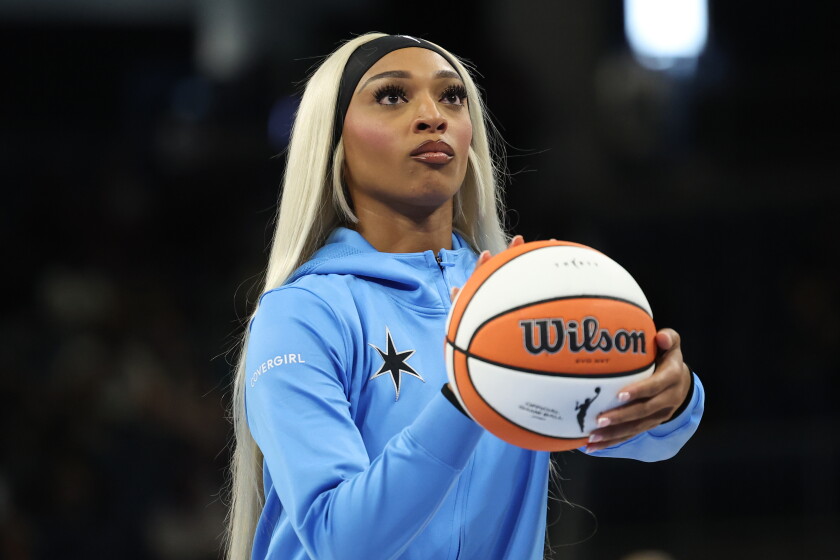
Suddenly, one Carrington foul on Cunningham reopened nearly three years of arguments about how Clark has been defended.
That is why the reaction became so intense.
Carrington already occupies a special place in Clark-related WNBA history.
During Game 1 of Indiana’s 2024 playoff series against Connecticut, Carrington attempted to contest a Clark pass.
Her hand came across Clark’s face.
One of her fingers struck Clark directly in the eye.
Clark went down in visible pain.
No foul was called on the play.
The slow-motion replay immediately went viral.
Clark eventually developed a black eye.
Fans analyzed Carrington’s hand movement frame by frame.
Some became convinced the contact was intentional.
Carrington firmly denied that.
She said she had been attempting to make a basketball play and did not intentionally strike Clark.
That should have ended the argument.
It did not.
Instead, the moment became one of the defining images surrounding Clark’s treatment during her rookie season.
Every new physical incident now gets connected back to it.
That is why Carrington’s recent confrontation with Cunningham immediately reopened the old wound.
Fans were not only watching one hard foul.
They were remembering a pattern.
Or what they believed was a pattern.
And that distinction matters.
Clark has unquestionably absorbed significant physical contact throughout her professional career.
Some of it has been legal.
Some has been ordinary basketball physicality.
Some has been upgraded to flagrant fouls.
Some has been missed by officials.
And some has created enormous controversy because viewers believed the contact looked unnecessary.
But those events do not automatically prove a coordinated campaign to injure her.
That is where the most dramatic version of the Stephen A. Smith narrative goes beyond the evidence.
There is a major difference between saying Clark receives excessive physical treatment and claiming WNBA players are collectively attempting to “physically eliminate” her.
The first is a legitimate sports debate.
The second requires evidence of coordination and intent.
No such evidence has been established.
Still, it is easy to understand why Clark supporters have become suspicious.
The list of controversial incidents is long.
During her rookie season, Chennedy Carter delivered a hard off-ball shoulder check that was later upgraded to a Flagrant 1.
Angel Reese struck Clark across the head while contesting a layup, another play upgraded to Flagrant 1.
Diamond DeShields knocked Clark violently to the floor during another Chicago matchup.
Clark also suffered significant contact on screens and defensive pressure throughout the season.
Clark herself complained early in her career that opponents were extremely physical with her.
But she also frequently resisted the most extreme interpretations.
After being struck by Reese, Clark described it as part of basketball and said Reese was attempting to make a play on the ball.
That detail often disappears from the viral narrative.
Clark can dislike physical treatment without believing everybody is trying to hurt her.
Those positions can coexist.
Professional basketball is physical.
Players can cross the line.
Officials can miss calls.
None of those automatically require conspiracy.

Yet Clark’s fame changes how every incident is perceived.
When another star gets fouled hard, fans may argue for an evening.
When Clark gets hit, the clip can dominate national sports television.
Her popularity raises the stakes.
Millions of people who might never watch another WNBA possession see the replay.
Then they ask a simple question.
Why does this keep happening?
Stephen A. Smith has repeatedly entered that conversation.
He has aggressively criticized what he views as failures surrounding Clark’s treatment and the league’s handling of its biggest attraction.
That makes him the perfect figure for viral headlines.
Stephen A. Smith.
Caitlin Clark.
DiJonai Carrington.
Put those three names together and the internet almost automatically expects an explosion.
But the recent Smith rant needs to be described accurately.
Carrington’s Flagrant 2 was against Sophie Cunningham.
Smith blasted White’s handling of the aftermath.
He questioned how Indiana’s own coach could initially speak positively about Carrington’s competitiveness while saying she had not completely seen the foul.
White later clarified herself.
She said the play was egregious once she reviewed it.
She emphasized that player safety remained a major priority.
And she pushed back strongly against suggestions that she did not protect her players.
That should have narrowed the controversy.
Instead, it widened it.
Because Cunningham has become one of the players most strongly associated with defending Clark.
During a 2025 Fever-Sun confrontation, Cunningham committed a hard foul on Jacy Sheldon after Clark had been poked in the eye and subsequently shoved by Marina Mabrey.
The altercation ended with multiple ejections and turned Cunningham into something of an “enforcer” figure among Clark supporters.
So when Carrington later delivered a hard foul against Cunningham, fans saw symbolism.
This was no longer simply Carrington versus Cunningham.
To some supporters, it became the latest chapter in the entire Clark physicality saga.
That emotional connection explains why viral posts can transform one incident into another.
Carrington hits Cunningham.
Smith attacks White.
Clark fans remember Carrington’s old eye poke.
Then a headline appears:
“STEPHEN A. SMITH DESTROYS CARRINGTON AFTER DIRTY HIT ON CAITLIN CLARK.”
The storyline feels familiar enough that people believe it immediately.
But familiarity is not verification.
And that matters because Carrington has faced extreme personal abuse before over Clark-related controversies.
Criticizing a foul is legitimate.
Demanding stronger officiating is legitimate.
Debating suspensions is legitimate.
Inventing malicious intent without evidence is not.
That is particularly important in a sport where physical plays happen at full speed.
Carrington’s 2024 contact with Clark looked horrific in slow motion.
Carrington denied intentionally poking her.
No evidence established otherwise.
Fans can remain skeptical.
But skepticism should remain skepticism.
The same standard should apply to every player.
If a foul is reckless, call it reckless.
If officials determine it is flagrant, say it was flagrant.
If the league suspends somebody, report the suspension.
But the word “attack” implies motive.
“Targeted campaign” implies coordination.
“Trying to eliminate Caitlin Clark” implies something far more serious than hard basketball.
Those claims require proof.
None currently exists.
The more powerful story is what all this says about the WNBA’s player-safety problem.
Because even without conspiracy, perception matters.
If millions of fans continually see Clark hit hard and believe officials are not protecting her, the league has a credibility issue.
Fair or unfair.
Officials cannot control every collision.
They can control consistency.
When contact reaches the head or neck, review standards must be clear.
When similar plays receive different penalties, people notice.
When star players appear frustrated by repeated contact, people notice.
And when viral clips look brutal, explanations must come quickly.
Otherwise, fan suspicion fills the vacuum.
Carrington’s recent Flagrant 2 against Cunningham became another example.
Officials reviewed it.
They ejected her.
That is exactly what a review system is supposed to accomplish.
The debate afterward should therefore focus on whether the punishment matched the act.
Instead, it expanded into everything Carrington has ever done.
Then into Caitlin Clark.
Then into race.
Then into media bias.
Then into accusations that the league itself has chosen sides.
That escalation is becoming almost predictable.
Clark has become more than a basketball player inside WNBA discourse.
She is a symbol.
To her strongest supporters, she represents the league’s growth.
To some critics, the attention surrounding her represents an unhealthy imbalance.
Every foul therefore becomes ideological.
It should not.
A foul should first be judged as basketball.
What happened?
Where was the contact?
Was the player making a legitimate basketball play?
Was the contact excessive?
Did the official make the correct call?
Those questions are complicated enough.
Stephen A. Smith naturally brings another level of intensity.
His job is confrontation.
He sees controversy and pushes directly into it.
That style works especially well when Clark is involved because the audience is already emotionally divided.
One side hears him and says:
“Finally, somebody is protecting Caitlin.”
Another hears the exact same commentary and says:
“He is manufacturing outrage.”
That conflict generates enormous attention.
But underneath the shouting sits a reasonable concern.
How physical should defenders be allowed to become with elite offensive stars?
There is no special Caitlin Clark rule.
There should not be.
She deserves the same officiating standards as everyone else.
But “same standards” cuts both ways.
Officials should not protect her because she is famous.
They also should not allow excessive contact because they fear appearing protective.
Call the game.
That sounds simple.
It rarely is.
Clark’s range makes her extremely difficult to defend normally.
Pick her up too low and she shoots.
Press too aggressively and she can drive.
Trap her and she passes.
Give her transition space and she can instantly create.
Those qualities naturally produce aggressive defensive schemes.
Face-guarding.
Holding through screens.
Physical pressure.
Full-court defense.
None of those are inherently dirty.
The line gets crossed when physicality stops serving a legitimate basketball purpose.
That is where officiating becomes essential.
Carrington is one of the league’s most aggressive perimeter defenders.
That style naturally creates collisions.
It also makes every controversial Carrington-Clark moment more explosive.
Fans already expect conflict.
Then slow-motion footage turns fractions of a second into something that looks deliberate.
Sometimes it may be reckless.
Sometimes it may simply look worse when slowed down.
Intent remains extremely difficult to determine from video alone.
That is why league discipline matters more than fan detective work.
Officials review angles unavailable in real time.
The league can assess penalties afterward.
That process will never satisfy everyone.
But it is more reliable than millions of people analyzing screenshots.
Stephen A. Smith can criticize the league.
Fans can demand better protection.
Carrington can defend herself.
Clark can respond however she chooses.
All of that belongs inside sports debate.
What should not happen is an unverified claim becoming accepted simply because it fits an existing narrative.
The newest viral version does exactly that.
It takes Smith’s real anger involving Carrington.
It takes Carrington’s genuine history with Clark.
It takes the real player-safety debate.
Then it combines them into a supposedly new Clark attack.
That final step is where the story loses factual support.
Ironically, the truth may be more revealing.
Smith did not need a new Carrington-Clark hit to become furious.
The Cunningham incident alone was enough.
And Clark did not need to be directly involved for her shadow to hang over the entire controversy.
That shows how powerful the Caitlin Clark effect has become.
Every Indiana Fever confrontation is interpreted through her.
Every Carrington incident gets connected back to her.
Every player-safety controversy becomes another referendum on whether the WNBA appreciates its biggest star.
That may be unfair to Clark too.
She repeatedly has to answer for narratives she did not create.
Other players’ actions get attached to her name.
Commentators turn normal basketball into culture-war material.
Then Clark receives criticism for the behavior of fans she does not control.
That cycle is exhausting.
The better approach is simple.
Judge each incident independently.
Carrington’s Flagrant 2 on Cunningham was reviewed and resulted in an ejection.
Carrington’s 2024 eye contact with Clark was highly controversial, but Carrington denied intentionality.
Smith recently attacked White’s response to the Cunningham incident.
Those facts are already explosive.
Nobody needs to invent another rant.
Nobody needs to invent a coordinated campaign.
And nobody needs to pretend hard fouls are harmless either.
Player safety matters.
So does accuracy.
Clark’s career deserves protection from reckless basketball.
Carrington’s reputation deserves protection from unsupported accusations.
Both statements can be true.
That is the piece often missing when social media goes nuclear.
Sports arguments do not require somebody to become a monster.
Sometimes a hard foul is simply a hard foul.
Sometimes a coach gives an unpopular answer.
Sometimes a television personality becomes furious.
And sometimes three separate stories are stitched together until nobody remembers which part actually happened.
This appears dangerously close to becoming one of those moments.
Stephen A. Smith absolutely entered the Carrington controversy.
He absolutely went off.
But the documented target of his outrage was Stephanie White’s handling of Carrington’s Flagrant 2 on Sophie Cunningham.
The notorious Carrington-Clark eye incident remains part of their history.
What remains unproven is the biggest viral allegation:
that Smith just exposed a deliberate Carrington-led campaign designed to physically eliminate Caitlin Clark.
Until evidence supports something that serious, it belongs in the category of fan theory.
Not fact.
And perhaps that is the real explosion.
Caitlin Clark has become so central to women’s basketball that she does not even need to be the player who gets hit anymore.
One Carrington foul.
One Stephen A. Smith rant.
One old Clark controversy.
And the entire basketball internet catches fire again.
The question now is not whether fans will keep arguing.
They will.
The question is whether the WNBA can establish clear enough standards that the basketball finally becomes louder than the conspiracy surrounding it.
Because until that happens, every hard hit will produce the same terrifying cycle.
Contact.
Replay.
Outrage.
Accusation.
War.
And Caitlin Clark’s name will somehow end up right in the middle of it.


