For a few heated seconds, the latest chapter of the Caitlin Clark–Angel Reese rivalry appeared ready to become something much bigger than basketball.
Reese went to the floor after a hard foul from Clark. She quickly jumped back up and moved toward the Indiana Fever guard. Clark turned away as players converged, but the confrontation had already changed the temperature inside Gainbridge Fieldhouse.
It looked personal.
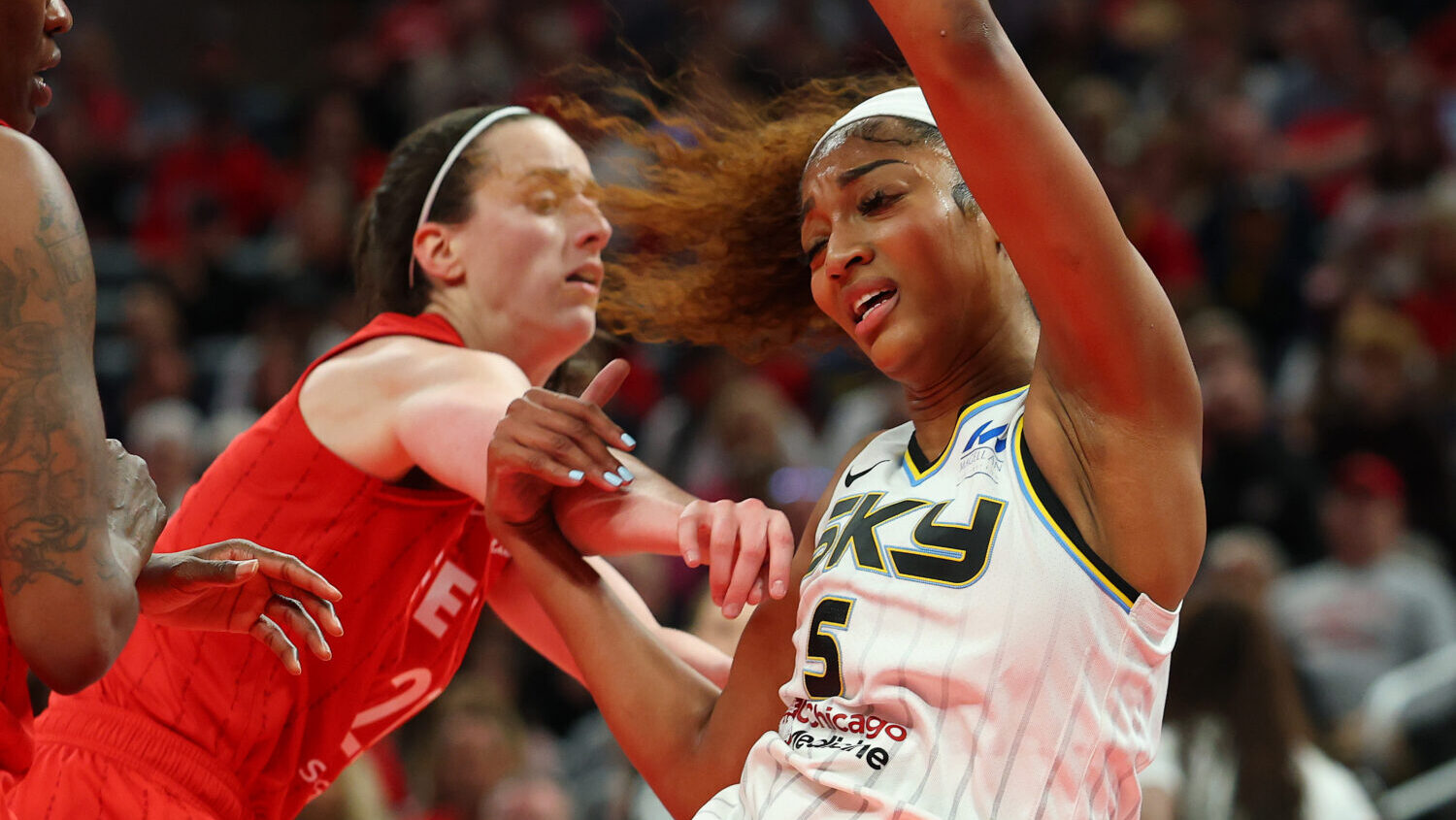
Then both players essentially insisted that it wasn’t.
That contradiction—not simply the contact itself—is what made the moment so compelling. The officials saw enough unnecessary force to upgrade Clark’s foul to a Flagrant 1. Clark and Reese, however, each framed the incident as a basketball play.
Those positions may sound incompatible, but the full sequence suggests they can both be true.
The incident occurred with 4:38 remaining in the third quarter of Indiana’s May 17, 2025 season opener against Chicago. The Fever were already in control of a game they would eventually win 93–58. Clark finished with 20 points, 10 rebounds, 10 assists and four blocks, while Reese recorded 12 points and 17 rebounds.
Because the final margin was so large, the confrontation did not decide the winner. Yet it became the game’s defining image because it concentrated years of rivalry, fan expectations and competing narratives into a single possession.
Reese had secured an offensive rebound when Clark reached across and made forceful contact, knocking the ball loose and sending Reese down. Reese immediately rose and attempted to confront Clark. Aliyah Boston stepped between them while Clark walked away from the developing exchange.
After reviewing the sequence, officials upgraded Clark’s foul to a Flagrant 1. Reese and Boston were also assessed technical fouls.
The distinction matters.
A take foul is often intentional in the most ordinary basketball sense. A defender knows she has been beaten or recognizes a dangerous transition opportunity, so she commits a foul to stop the possession. That does not automatically mean the player wants to injure or intimidate an opponent.
Clark’s strongest defense is that she appeared to be trying to stop the play and make contact with the ball. She later rejected the idea that the foul was malicious and described it as a take foul. Reese also offered a brief assessment: it was a basketball play.
But basketball intent does not erase unnecessary contact.
The officials did not need to determine that Clark held a personal grudge against Reese. They only needed to evaluate the physical action. Crew chief Roy Gulbeyan explained that the wind-up, impact and follow-through—particularly the extension of Clark’s hand into Reese’s back—met the criteria for a Flagrant 1.
That ruling leaves room for a more balanced conclusion: Clark may have intended to stop a basketball play, but the way she executed the foul still crossed the officiating threshold.
Reese’s reaction added another layer.
A player who has just been knocked down does not have the benefit of an instant replay or a calm postgame explanation. Reese felt the contact, hit the floor and responded in real time. Her decision to move directly toward Clark made the incident appear more personal than either player later admitted.
At the same time, the confrontation never became a prolonged fight. Teammates stepped in, Clark disengaged, and the game continued. Reese’s technical addressed her response after the foul, while Clark’s flagrant addressed the contact that began the entire sequence.
The two penalties judged different actions.
That is why attempts to identify a single villain miss the most interesting part of the moment. Clark’s foul can be excessive without being motivated by hatred. Reese’s reaction can escalate the scene while still being understandable from the perspective of the player who absorbed the contact.
The rivalry surrounding them makes that distinction difficult to preserve.
Clark and Reese have been connected since their college careers, particularly after LSU defeated Iowa in the 2023 national championship game and Iowa won the highly watched rematch one year later. Every professional matchup since then has carried the weight of that history, even when the players themselves have resisted turning it into a personal feud.
As a result, nearly every hard foul, celebration or facial expression becomes evidence for a story fans have already chosen to believe.
Clark supporters may see a star finally refusing to be pushed around. Reese supporters may see another example of their player being judged more harshly for responding than the opponent who initiated the contact. Neutral viewers may see exactly what both players claimed afterward: a physical basketball play magnified by the names involved.
What happened after the review offers the clearest payoff.
Reese made one of her two free throws, and Chicago scored on the ensuing possession to reduce Indiana’s lead to 56–45. If the confrontation was supposed to rattle the Fever, it failed. Indiana answered with nine consecutive points to end the quarter ahead 65–45, then continued pulling away toward the 35-point victory.
The emotional moment belonged to the rivalry. The basketball response belonged to Indiana.
That is the contradiction the short confrontation reveals. The officials evaluated Clark’s physical action and ruled that it was unnecessary. Clark and Reese evaluated the motive behind the moment and refused to make it personal. The scoreboard then reduced the entire incident to a brief interruption in a dominant Fever performance.
A flagrant foul does not prove personal hostility. Calling something a basketball play does not automatically make the contact ordinary. Both realities can exist within the same possession.
The remaining question is not whether Clark and Reese secretly dislike each other—neither the footage nor their comments can prove that. It is whether any physical moment between them can still be treated as ordinary basketball once millions of viewers are waiting for evidence of something more.


