The Supreme Court Did Reject Christa Pike’s Final Stay, but the Viral Riverbend Defense-Team Audio Is Unverified
Christa Pike’s final Supreme Court effort to stop her scheduled execution was rejected on September 29, 2026.
That part of the viral claim is accurate.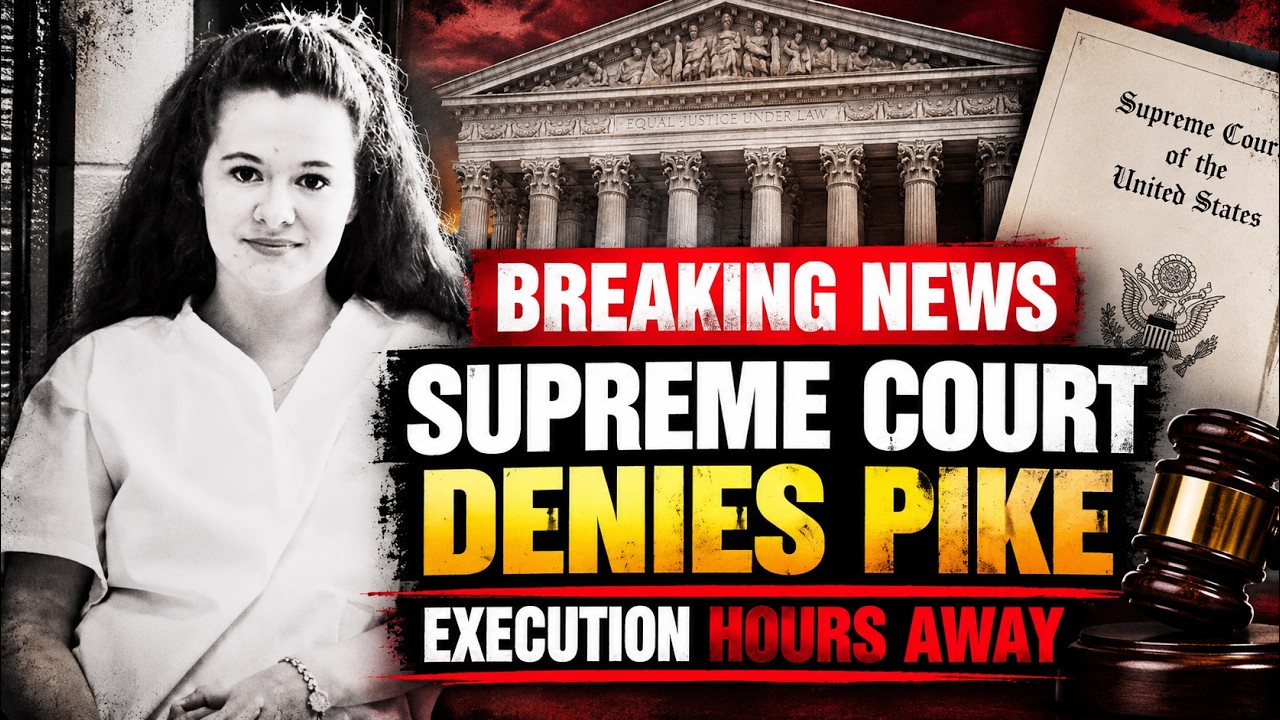
The United States Supreme Court denied Pike’s application for a stay of execution and separately denied her petition for a writ of certiorari.
The Court’s order was extremely brief.
It said Pike’s stay application was denied and her certiorari petition was denied.
That left Tennessee’s September 30 execution order in place.
Reuters reported on September 30 that Pike remained scheduled to die by lethal injection at Riverbend Maximum Security Institution in Nashville.
She is Tennessee’s only female death-row prisoner.
If Tennessee carries out the sentence, Pike would become the first woman executed by the state in more than two centuries.
Those facts make the legal situation genuinely extraordinary.
But the viral story adds an alleged private scene that is not supported by the public record.
I found no authenticated ten-second recording of Pike’s attorneys speaking to her inside Riverbend.
No credible source confirms her lead lawyer told her on a leaked audio file that the execution team had entered “final staging.”
No Tennessee Department of Correction release authenticates such a recording.
And no current Reuters report describes reporters obtaining private defense-team audio from inside the prison.
The Supreme Court docket identifies Pike’s counsel of record as Luke Parker Ihnen of Federal Defender Services of Eastern Tennessee.
The docket shows that Pike’s team filed the certiorari petition and stay application on September 25.
Tennessee filed its opposition on September 28.
Pike then filed a reply.
The Court denied both requests on September 29.
That chronology is public and verifiable.
The alleged private Riverbend conversation is not.
The Court’s order itself is even more restrained than the viral caption suggests.
It does not contain an explanation of the justices’ reasoning.
It does not describe Pike’s claims as frivolous.
It does not use emotionally charged language.
It simply denies the stay and denies certiorari.
Calling that a “brutal one-line order” is rhetorical framing.
The legal effect was unquestionably severe because it removed a major avenue for stopping the execution.
But the document itself is procedural and concise.
There is also an important distinction between the two things the Court rejected.
A stay application asks the Court to halt the execution temporarily.
A petition for certiorari asks the justices to review the underlying legal dispute.
The Court declined both.
That meant Pike did not receive either immediate relief or full Supreme Court review.
Her underlying litigation had focused heavily on Tennessee’s execution procedures.
The state’s Supreme Court filing recounts that Pike challenged Tennessee’s lethal-injection protocol under the Eighth Amendment.
Her lawyers argued that her psychological conditions, including complex PTSD, could make the execution process uniquely traumatic for her.
They also challenged aspects of the physical procedure leading into the execution.
The state opposed those claims.
Tennessee argued Pike had not established a constitutional basis for stopping the sentence.
That method-of-execution litigation had been unfolding for months.
Pike first filed a declaratory and injunctive action in Davidson County Chancery Court on January 8, 2026.
The case then moved through unusual procedural steps involving the Tennessee Supreme Court.
On June 12, Pike filed a motion challenging the lethal-injection protocol directly in Tennessee’s high court.
Among other things, she argued that her psychiatric conditions created a substantial risk of severe psychological suffering during the process.
Those arguments formed part of the litigation eventually reaching the United States Supreme Court.
The state continued opposing relief.
Its September 28 filing argued that Pike’s challenges did not justify halting the execution.
The Supreme Court ultimately sided with Tennessee procedurally by declining to intervene.
The denial does not mean the Court issued a full opinion endorsing every part of Tennessee’s protocol.
It means Pike failed to obtain the extraordinary relief she was seeking before the scheduled execution.
That distinction is important.
A denial of certiorari is not normally a ruling on every legal argument’s merits.
The Court regularly denies petitions without explanation.
The same is true here.
There was no lengthy majority opinion.
There was no publicly released factual finding that every allegation in Pike’s filings was false.
There was simply no Supreme Court intervention.
The viral language saying her “last legal lifeline was officially destroyed” is therefore understandable as dramatic shorthand.
But legally, the precise event was the denial of her stay application and certiorari petition.
That is what the Court actually did.
Her clemency effort had already failed separately.
Governor Bill Lee declined to commute Pike’s sentence.
Reuters reported that both Lee’s refusal and the Supreme Court’s denial left the execution scheduled to proceed.
Clemency and Supreme Court review are different processes.
Clemency is an executive decision.
A Supreme Court stay is judicial relief.
Pike pursued both.
Both failed.
That combination is what created the legal finality surrounding September 30.
The viral caption says Pike had “exhausted every constitutional avenue and clemency maneuver.”
That is broadly descriptive of how narrow her options had become.
But death-penalty cases can still generate extremely late litigation.
Emergency filings can be submitted close to an execution time.
Administrative developments can occur.
A governor theoretically retains certain executive powers.
So the safest formulation before an execution is completed is that the major publicly reported avenues had failed.
Reuters reported precisely that posture on the morning of September 30.
Pike remained scheduled for lethal injection after the governor and Supreme Court declined to intervene.
The claim about “final staging” is much less verifiable.
Correctional departments use detailed internal execution procedures.
Staff must prepare the chamber.
Medical equipment must be checked.
Witnesses must be processed.
Security must be assigned.
The condemned prisoner must be monitored and eventually moved according to protocol.
Those operational steps obviously exist.
But the phrase “the lethal injection team has officially entered final staging” does not appear in the Supreme Court order.
It does not appear in Pike’s public docket.
And no credible news source currently attributes that exact phrase to Tennessee corrections officials.
That matters because the viral post presents the sentence like official terminology.
It may not be.
The state’s documents use formal execution-protocol language rather than dramatic countdown terminology.
The public legal filings provide a clearer picture of what Tennessee planned.
Pike’s litigation challenged how she would be confined and physically handled before the execution.
The state’s response confirms the existence of detailed procedures governing the process.
Separate filings also show that Pike’s attorneys were actively seeking information about Tennessee’s execution procedures.
One Tennessee Supreme Court filing discusses a dispute over subpoenas and the state’s execution-secrecy statute.
Pike’s lawyers accused the state of withholding information about the lethal-injection protocol.
The state argued that certain details were protected.
That secrecy dispute is real.
It helps explain why claims of leaked prison audio can sound plausible.
There genuinely are execution details that Tennessee does not disclose publicly.
But secrecy is not evidence that every alleged leak is authentic.
A recording still needs provenance.
Who made it?
Where was the microphone?
When was it recorded?
Who confirms the voices?
Was the audio edited?
Does the full recording exist?
No reliable answer to those questions accompanies the alleged ten-second defense-team clip.
The viral claim also says Pike’s lead counsel was “inside Riverbend” when the audio was captured.
Public court records identify Pike’s lawyers.
They do not document this particular meeting or recording.
Attorney-client communications are normally privileged.
That makes the idea of a genuine leaked recording especially significant.
If such a recording existed, credible reporting would need to explain how a confidential legal conversation became public.
No major current source has done so.
The absence is notable because Pike’s execution has national attention.
Reuters is covering it.
Associated Press is covering it.
Tennessee media outlets are covering it.
Human-rights organizations and death-penalty researchers are following every legal filing.
A genuine recording of defense counsel informing a condemned prisoner that the Supreme Court had rejected her final plea would be major evidence.
It would not likely remain dependent on a social-media keyword.
The Supreme Court’s own documents are already available openly.
There is no need to obtain an “unredacted ruling” through private messages.
The docket provides the order publicly.
The September 29 order reads:
“The application for stay of execution of sentence of death presented to Justice Kavanaugh and by him referred to the Court is denied.”
It then states that the certiorari petition is denied.
That is the actual ruling.
There is no hidden longer opinion behind the public version.
The viral CTA implying that an “unredacted Supreme Court ruling” must be obtained privately is therefore misleading.
The publicly released document is the ruling.
The Court did not publish a redacted version concealing secret reasoning.
Its brevity is normal for many emergency-order dispositions.
The docket also makes clear that Justice Brett Kavanaugh initially received the stay application before referring it to the full Court.
That procedural detail is public.
There is no evidence of a separate secret order.
The legal dispute itself stretches back decades.
Pike was sentenced to death for the 1995 killing of 19-year-old Colleen Slemmer.
Pike was 18 when the crime occurred.
Her then-boyfriend, Tadaryl Shipp, was 17 and received a life sentence rather than death.
A third participant received a far lighter sentence.
That sentencing disparity became a major part of Pike’s clemency arguments.
Her attorneys also cited severe childhood abuse, mental illness and neurological impairment.
They argued that those factors were not adequately understood when she was sentenced.
Governor Lee nevertheless declined clemency.
The victim’s family has strongly supported carrying out the sentence.
That conflict between mitigation and retribution has defined much of the final public debate.
It also explains why Pike’s last litigation attracted such intense attention.
The Supreme Court denial did not resolve those moral disagreements.
It resolved only whether the Court would stop the execution.
It would not.
The viral claim’s phrase “clearing the runway” is therefore metaphorically accurate regarding the immediate legal effect.
Tennessee remained authorized to proceed.
But the Court did not issue an affirmative command ordering corrections officials to begin a particular operational stage.
The underlying death warrant already did that work.
The Supreme Court simply declined to interfere.
That distinction matters.
The execution authority came from Tennessee’s judgment and execution order.
The U.S. Supreme Court did not create the sentence.
It refused to stay it.
The state’s September 30 execution date had been set a year earlier.
According to Tennessee’s filing, the Tennessee Supreme Court set Pike’s execution date for September 30, 2026, on September 30, 2025.
The final federal litigation happened against that existing deadline.
Pike’s attorneys therefore knew precisely when the execution was scheduled.
Their emergency application sought to stop an already active state order.
Once the Supreme Court denied relief, no federal stay stood in Tennessee’s way.
That is the real significance of the September 29 order.
The defense team’s emotional reaction remains unknown publicly.
It would be entirely understandable if Pike’s lawyers were devastated.
Capital-defense attorneys spend years litigating cases.
A final denial hours before an execution can carry enormous emotional weight.
But understandable emotion is not evidence of a particular recorded conversation.
No reliable source currently says Luke Ihnen or another attorney broke down while informing Pike.
No reputable source quotes counsel telling Pike “the execution order stands.”
And no authenticated audio captures that moment.
The viral story also claims the audio was recorded “inside Riverbend.”
That raises additional security questions.
Riverbend Maximum Security Institution is a controlled correctional environment.
Electronic recording access is restricted.
Execution-day movements are tightly regulated.
Any unauthorized audio from inside a secure execution area would itself be a significant breach.
A credible leak would likely prompt questions from Tennessee officials.
No such confirmed incident appears in current reporting.
The stronger factual story is therefore already dramatic enough.
On September 25, Pike asked the U.S. Supreme Court to intervene.
On September 28, Tennessee opposed her request.
On September 29, the Court denied both the stay and certiorari.
On September 30, Reuters reported Tennessee remained prepared to carry out the execution.
That sequence is fully documented.
There is no need for secret prison audio to establish the gravity of the moment.
The Court’s order itself provides legal finality.
Its brevity arguably makes the moment even starker.
Decades of litigation ended at the Supreme Court with only a few lines.
But the wording should not be exaggerated.
The justices did not call Pike’s claims absurd.
They did not accuse her lawyers of delaying tactics in the order.
They did not issue a moral judgment about her.
They did not discuss Slemmer’s murder in the document.
They simply declined to grant relief.
That is the accurate description.
The viral CTA’s promise of a “full leaked defense audio” presents another common verification problem.
A short clip could theoretically contain a lawyer discussing the denial.
Even then, that would not automatically authenticate every caption attached to it.
The clip could be recorded somewhere else.
The speaker could be another attorney.
The phrase “final staging” could be added through subtitles.
The recording could have been edited.
A genuine conversation could be recut to make it sound more dramatic.
Authentication would require the original file and independent confirmation.
None has surfaced through a credible source.
The same caution applies to any alleged prison lockdown footage.
Pike’s final-hours confinement has been discussed in court filings.
That is different from secret audio documenting it.
Court filings can be cited.
Anonymous clips require verification.
This distinction becomes especially important during a rapidly developing execution.
Rumors spread quickly because audiences know the event is occurring behind prison walls.
Most people cannot independently observe what is happening.
That creates a vacuum.
Into that vacuum come claims about guards, lawyers, spiritual advisers, medical teams and final conversations.
Some may be accurate.
Others may be invented.
The safest approach is to rely on documents, official announcements and credentialed witnesses.
At the moment, those sources confirm the legal denial.
They do not confirm the private audio.
There is also a timing issue.
The user’s claim describes the execution team as having “officially entered final staging.”
Even if Tennessee had begun final preparations, that would be an operational fact potentially changing minute by minute.
Without a timestamped TDOC statement, it should not be presented as a formal announced status.
Reuters says Pike is scheduled for execution at Riverbend.
That confirms the state is preparing to proceed.
It does not provide the alleged phrase.
The difference is small rhetorically but important factually.
The Supreme Court docket offers another reason to distrust claims of a secret “unredacted” ruling.
Every major filing is listed publicly.
The petition is there.
The stay application is there.
Tennessee’s opposition is there.
Pike’s reply is there.
And the denial is publicly linked.
The legal record is unusually accessible.
Anyone can verify the final order directly.
The sensational part of the post is therefore not the ruling.
It is the alleged emotional recording.
That is precisely the portion lacking evidence.
The public can confidently say that Pike’s Supreme Court effort failed.
The public cannot confidently say what her lawyer privately told her afterward.
Those are two different levels of knowledge.
Likewise, the public can say Tennessee was still preparing to execute Pike.
The public cannot say corrections officials had entered a specifically named internal “final staging” phase unless Tennessee confirms that terminology.
The legal history behind the denial also remains contested.
Pike’s lawyers say her trauma and mental-health history matter profoundly.
The state says the sentence remains constitutional and should be enforced.
The Supreme Court’s refusal to grant review does not settle that debate philosophically.
It settles the immediate question of federal intervention.
The victim’s family may see the denial as an overdue step toward finality.
Death-penalty opponents may see it as a failure to account sufficiently for youth and trauma.
Those perspectives remain.
The order itself does not choose language from either side.
It is procedural.
The execution’s historic dimension remains undeniable.
Pike is the only woman on Tennessee death row.
She would be the first woman Tennessee has executed in more than two hundred years.
She was 18 when Slemmer was killed.
Those facts alone make the case exceptional.
Her final Supreme Court denial adds another major historical marker.
But historical importance does not authenticate every rumor surrounding the final hours.
As of September 30, the factual record can be separated cleanly.
Christa Pike filed an emergency stay application with the U.S. Supreme Court.
Verified.
She also filed a petition for certiorari.
Verified.
Tennessee opposed both forms of relief.
Verified.
The Supreme Court denied the stay on September 29.
Verified.
The Court also denied certiorari.
Verified.
The order was extremely short.
Verified.
Governor Bill Lee had already declined clemency.
Verified by current reporting.
Tennessee continued preparing for Pike’s September 30 lethal injection at Riverbend.
Verified.
A leaked ten-second recording captured Pike’s lead lawyer inside Riverbend informing her of the denial.
Not verified.
The attorney was recorded in “absolute devastation.”
Not verified.
The lethal-injection team formally announced it had entered “final staging.”
Not established by the public sources reviewed.
A private prison recording authenticates that phrase.
Not verified.
A longer “unredacted” Supreme Court ruling exists behind the short public order.
False as far as the public docket shows; the short order is the Court’s published disposition.
The legal blow was real.
The Supreme Court did leave Tennessee free to proceed.
The order was final enough to remove Pike’s major pending Supreme Court obstacle.
But the alleged defense-team recording remains unsupported.
The most consequential document is not hidden in a direct message.
It is already public on the Supreme Court’s website.
And its message is stark enough without embellishment: Pike’s request to stop the execution was denied.


