For one possession, the roles in the Caitlin Clark–Angel Reese rivalry completely reversed.
This time, Clark delivered the hard foul. Reese went to the floor. Reese rose in anger, and Clark became the player walking away while teammates and officials prevented the confrontation from growing.
The reversal should have produced a simple conclusion.
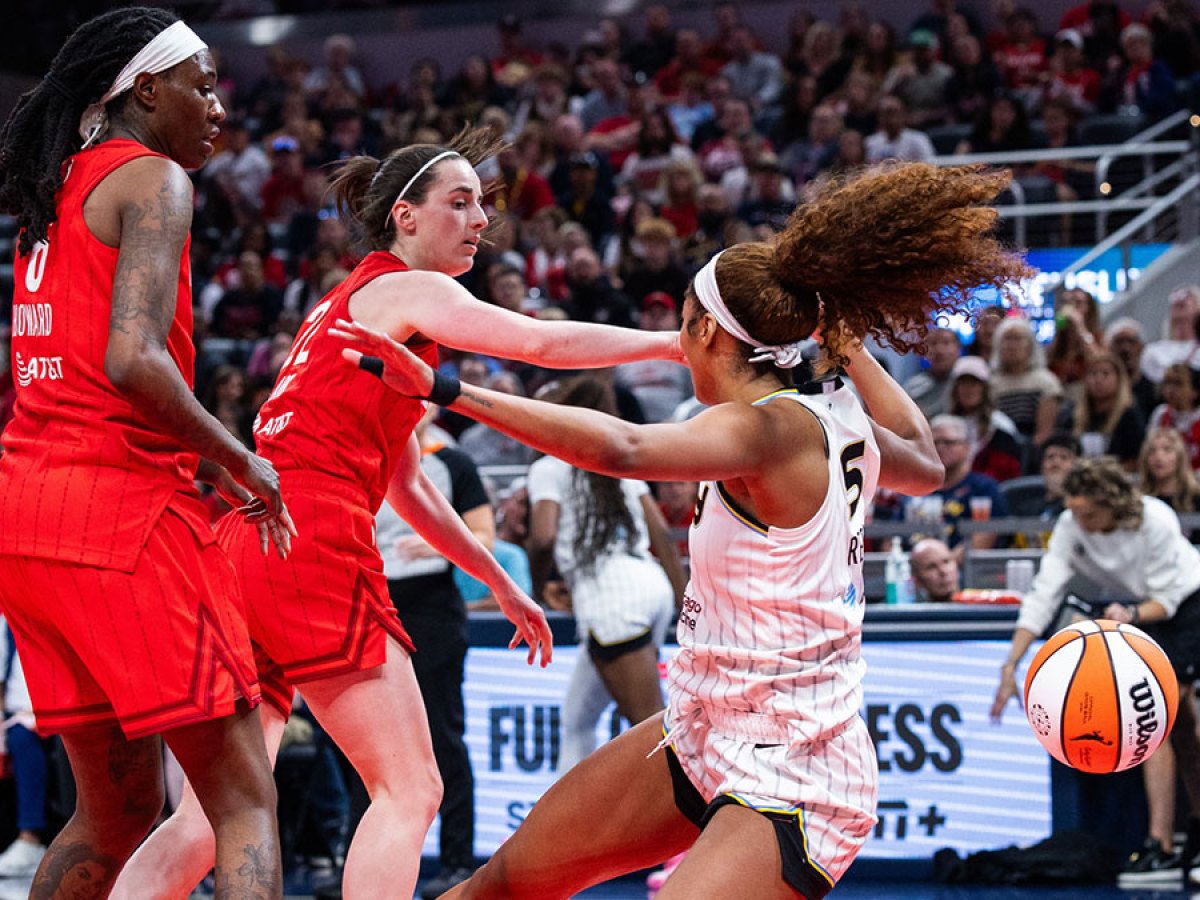
Instead, it exposed the same unresolved contradiction that had followed both players since their rookie season: how can an incident look so personal while the participants continue insisting it is only basketball?
The play occurred with 4:38 remaining in the third quarter of Indiana’s May 17, 2025 season opener against Chicago.
Reese secured an offensive rebound with an opportunity to score. Clark stepped in to prevent the easy basket, reaching across Reese’s arm and knocking the ball loose. The force of the contact sent Reese to the floor.
Reese immediately jumped back up and moved toward Clark. Aliyah Boston placed herself between them as Clark disengaged and walked away.
Following a replay review, officials upgraded Clark’s foul to a Flagrant 1. Reese received a verbal technical, while Boston was assessed a technical for her role in the confrontation.
The ruling created two separate questions.
The first concerned strategy: was Clark correct to commit the foul rather than allow Reese an uncontested basket?
The second concerned execution: did the additional contact exceed what was necessary to stop the play?
Clark had a strong defense on the first question. Reese had secured the ball close to the basket, and conceding a foul could be preferable to allowing an easy two points. Take fouls are intentional by definition, but they are not automatically hostile or malicious.
Clark described it that way afterward. She said she had been making a play on the basketball and rejected the suggestion that she intended to hurt Reese.
Reese offered an equally brief assessment: it was a basketball play.
The officials did not need to accuse Clark of malicious intent to reach a different conclusion. Their explanation focused on the mechanics of the foul—the wind-up, impact, follow-through and extension into Reese’s back. Those elements caused the contact to be classified as unnecessary.
Both explanations can therefore be true.
Clark may have wanted only to stop the basket. The movement she used to accomplish that goal may still have crossed the Flagrant 1 threshold.
The sequence after the whistle made the moment feel less ordinary.
Reese did not remain on the floor waiting for the officials. She rose immediately and moved toward Clark, creating the appearance of a direct confrontation. Boston intervened, Clark walked away and Reese continued reacting as the players were separated.
That response does not prove a private feud. It does show that Reese experienced the foul as serious enough to demand an immediate reaction.
Boston’s involvement added another layer. From Indiana’s perspective, she was protecting her teammate and preventing Reese from advancing. From the officials’ perspective, part of her intervention qualified as a physical taunt worthy of a technical.
That distinction illustrates how rapidly basketball situations become difficult to separate. A player can protect a teammate while also escalating contact. A player can commit a strategic foul while using unnecessary force. A player can confront an opponent without proving that the conflict extends beyond the court.
The game context made the confrontation even more revealing.
Indiana was already moving toward a dominant opening-day victory. Clark finished with 20 points, 10 rebounds, 10 assists and four blocks. Reese posted 12 points and 17 rebounds, but Chicago lost 93–58.
The altercation gave Chicago a brief opportunity to respond.
Reese made one of two flagrant-foul free throws, and Courtney Vandersloot scored on the ensuing possession to reduce Indiana’s lead to 56–45. For a moment, the emotional confrontation appeared capable of changing the game.
Indiana answered with nine consecutive points to close the third quarter ahead 65–45. Chicago never recovered.
That response supplied the final twist.
The rivalry owned the viral moment, but the Fever controlled what happened next. Clark did not retaliate when Reese approached. Indiana did not lose its structure after the technicals. The team converted the disruption into a decisive closing run.
The three incidents across this series now form an uncomfortable pattern without proving a coordinated motive.
First, Carter knocked Clark down away from the ball and Reese appeared to celebrate.
Next, Reese struck Clark across the head while attempting to block a shot, and Clark defended her opponent’s intention.
Finally, Clark fouled Reese hard enough to receive her own Flagrant 1, while both stars again dismissed the idea that the moment was personal.
The actions changed. The public argument remained almost identical.
Fans judged motive from body language. Officials judged contact through replay. The players attempted to separate intense competition from personal hostility.
The most reasonable conclusion is less dramatic but more revealing: a rivalry can be real without becoming hatred. Players can recognize the importance of a matchup, respond emotionally and occasionally cross the officiating line without secretly attempting to harm one another.
That does not make every foul acceptable. It means the ruling should address the action without pretending it can reveal the player’s mind.
Clark’s Flagrant 1 was justified by the officials’ interpretation of the movement. Reese’s anger was understandable after being sent to the floor. Their shared refusal to label the incident malicious was also meaningful.
The rivalry does not require an invented feud. The basketball has already created enough conflict on its own.


