One fast-break possession changed the temperature of the Indiana Fever–Chicago Sky matchup.
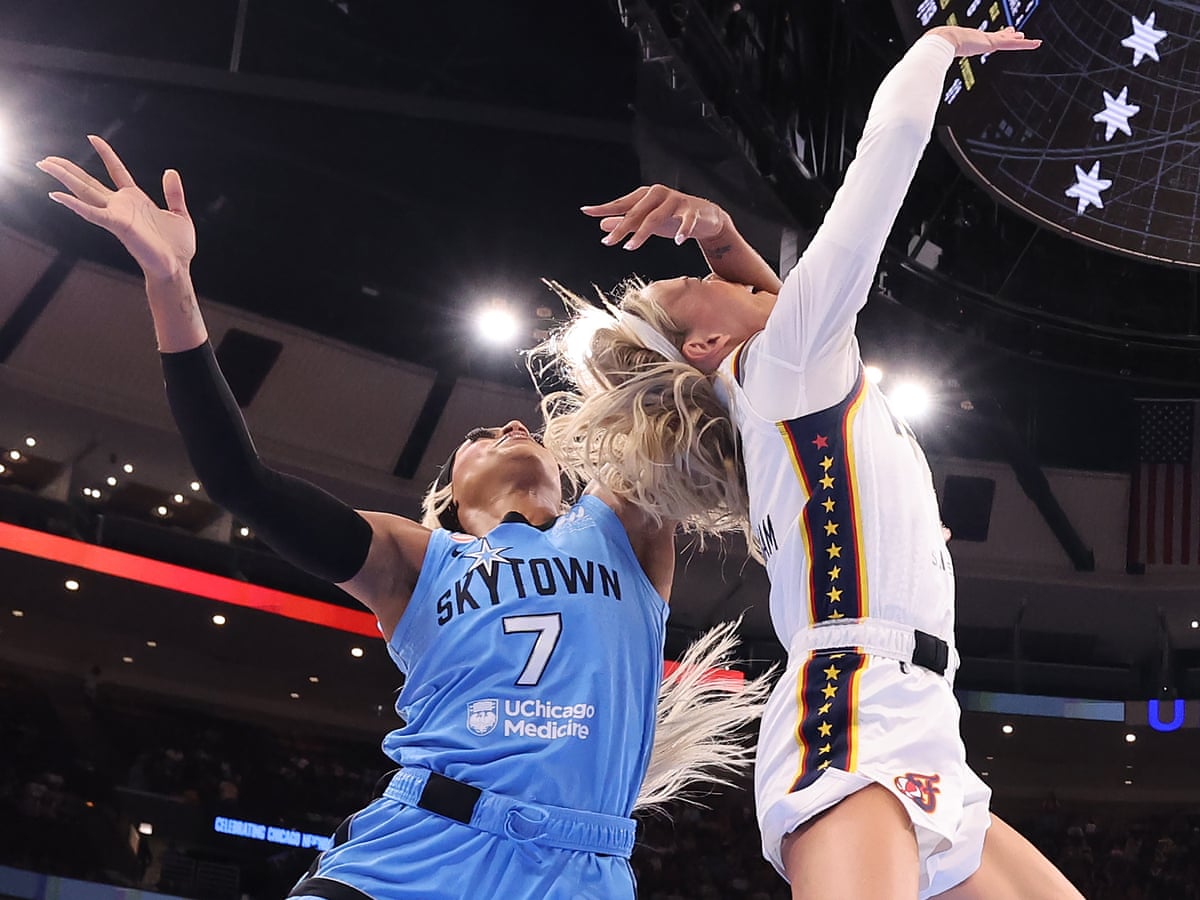
Sophie Cunningham appeared to have a clear path toward the basket. DiJonai Carrington refused to concede the layup, chased the play from behind and attempted to intervene before Cunningham could finish.

The basket went in. Carrington’s arm also came down across Cunningham’s head and neck area, leaving the Indiana guard unable to protect herself as she fell to the floor.
Then came the reaction that turned a hard foul into a confrontation.
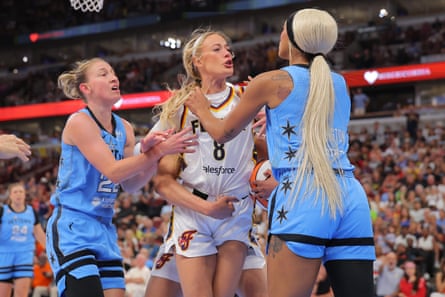
Cunningham jumped up and moved directly toward Carrington. The two players came face-to-face before Indiana teammate Makayla Timpson wrapped up Cunningham and helped prevent the moment from escalating.
That sequence created two separate questions.
The first was comparatively simple: Did the contact meet the standard for an ejection?
The second was much harder: Did Carrington intend to deliver that level of contact, or did an aggressive attempt to stop a layup become dangerous because of speed, timing and Cunningham’s vulnerable position?
Those questions are related, but they are not identical.
A player does not need to begin a possession with malicious intent for the resulting contact to be excessive. Basketball decisions happen in fractions of a second. A defender can legitimately pursue the ball and still make a reckless play that deserves a severe penalty.
That distinction became the center of the debate.
Carrington had entered the game and immediately provided Chicago with energy. She scored eight points in only a few minutes, helping the Sky reverse Indiana’s early momentum. The official Chicago recap described a competitive game in which the Sky eventually recovered from a deficit as large as 17 before losing 90–86.
From Carrington’s perspective, the chase made basketball sense. Allowing an uncontested fast-break layup would have surrendered two easy points. She had enough athleticism to pursue Cunningham and at least attempt a block.
The problem was how that attempt ended.
Carrington did not merely bump Cunningham’s shoulder or make incidental contact while reaching toward the ball. Her left arm came across the head and neck area while Cunningham was airborne. The force of the contact prevented Cunningham from controlling her landing.
That vulnerable position mattered as much as the point of contact.
Fever coach Stephanie White later offered perhaps the strongest defense of Carrington. White said she did not believe Carrington deliberately set out to catch Cunningham across the neck, even though she agreed that the resulting ejection was the correct decision.
Sky coach Tyler Marsh also said his initial live impression was that Carrington was attempting to make a play on the ball. He questioned whether the action deserved the most severe flagrant classification, while acknowledging that he had not yet reviewed the replay when he made those comments.
Those defenses address motive. They do not erase the result.
Replay gave officials several elements to evaluate: the downward motion of Carrington’s arm, the impact above Cunningham’s shoulders, the follow-through and the risk created by striking an airborne player.
The foul was ultimately upgraded to a Flagrant 2, producing an automatic ejection.
Cunningham believed the play was unnecessary and later said she thought the contact was intentional. She also indicated there had been no established personal conflict between them before the incident.
That made her immediate response revealing—but not conclusive.
Cunningham’s decision to get up and confront Carrington demonstrated how she interpreted the contact in the moment. It does not prove what Carrington intended before swinging her arm. Players who absorb dangerous contact often react before they have seen the replay or considered alternative explanations.
Officials did not penalize Cunningham for that response. Crew chief Maj Forsberg later said her reaction was considered acceptable given the severity of the contact.
That decision created another layer of disagreement. Some viewers saw Cunningham’s reaction as understandable self-defense. Others questioned how far a player should be permitted to advance toward an opponent without receiving a technical foul.
Ultimately, the replay resolved the rule classification but not the argument over motive.
Carrington’s pursuit could have begun as a legitimate basketball decision. Cunningham’s position in the air, the high point of contact and the forceful follow-through still made the outcome excessive enough for an ejection.
Both statements can be true.
The most productive question is therefore not simply whether Carrington “went for the ball.” It is whether that intention should carry much weight once the attempted block places an airborne opponent at significant risk.
Officials answered the rulebook question with a Flagrant 2.
The footage left everyone else debating where competitive urgency ended—and reckless contact began.


