Caitlin Clark Took Control of Game 2, but the Viral “Rogue” Huddle Fight With Stephanie White Is Unverified
Caitlin Clark absolutely took control Tuesday night, but the evidence shows something very different from an open rebellion against Stephanie White.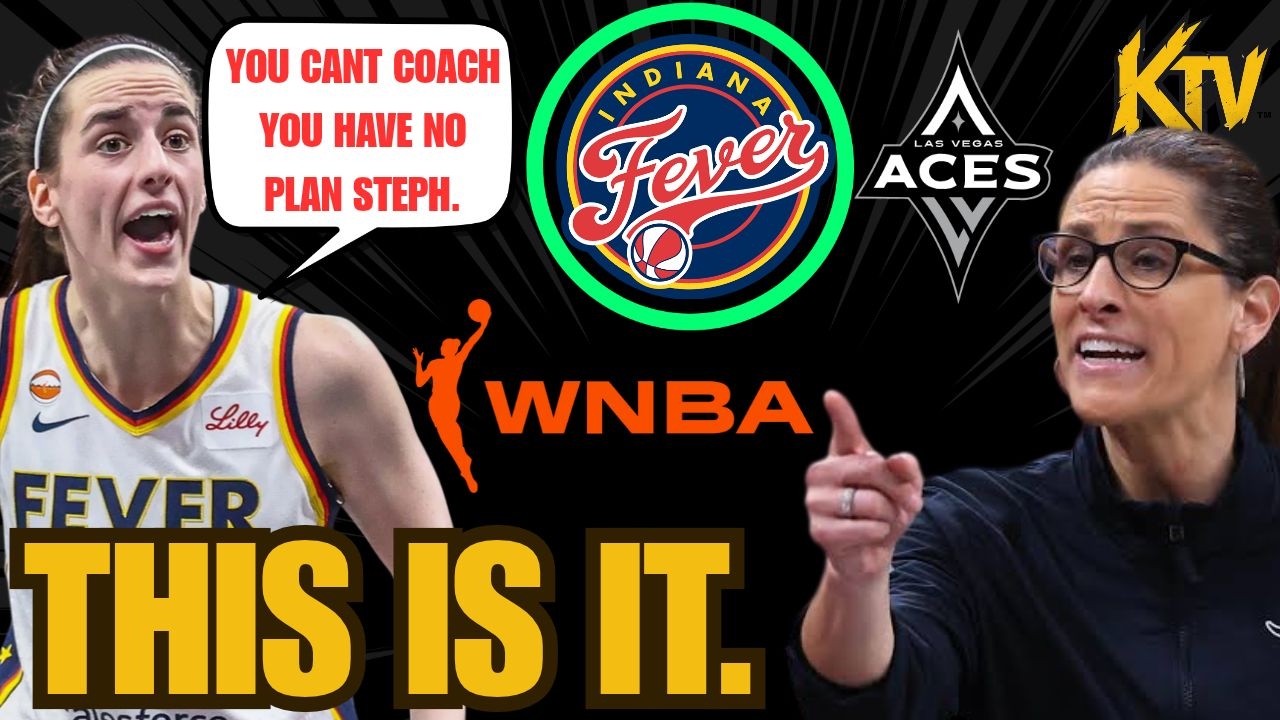
Indiana entered Game Two against Las Vegas with its season one defeat from ending.
The Fever responded with a 99-89 victory that forced a deciding Game Three Thursday night in Las Vegas.
Clark delivered one of her strongest playoff performances.
She finished with 27 points, 15 assists and seven rebounds while repeatedly pushing Indiana’s offense before Las Vegas could establish its defense.
Kelsey Mitchell scored 26 points.
Aliyah Boston added 22.
Together, Indiana’s three primary stars produced 75 points in the elimination-game victory.
Clark was especially dominant before halftime.
She reached 14 points and 11 assists in the opening twenty minutes, becoming the first player in WNBA history with a first-half points-assists double-double in a playoff game.
That performance understandably created the impression that Clark had decided to seize control.
What current reporting does not show is Clark doing that against her own coaches.
No credible current source reports Clark cursed at White during a timeout.
No authenticated nine-second courtside recording contains Clark telling White to “back off.”
No reliable outlet reports Clark refused to execute White’s play calls and substituted her own offense against direct coaching instructions.
No official league account documents a bench confrontation serious enough to represent insubordination.
And Indiana’s own postgame media provides evidence inconsistent with the dramatic version circulating online.
White, Clark and rookie guard Raven Johnson appeared together following the victory.
The Fever’s official description says the three spoke jointly with reporters after Indiana evened the series.
White did not describe a rebellion.
Instead, she publicly praised Clark’s performance.
“I thought her energy from start to finish” was exceptional, White said after Clark produced the historic first-half double-double.
That does not mean Clark and White agreed on every basketball decision.
Star point guards regularly adjust actions on the floor.
They read defenses.
They reject screens.
They wave teammates into different positions.
They call audibles.
They push pace before coaches can call structured offense.
Clark does all of those things by design.
None automatically constitutes going “rogue.”
Indiana actually needed Clark to play aggressively Tuesday.
Game One had been a disaster.
Las Vegas won 102-85 while scoring 28 points off Indiana turnovers.
Clark finished Game One with 15 points and ten assists but also committed six turnovers.
Indiana’s offense repeatedly became stagnant.
Clark afterward described its actions as sloppy and acknowledged the Fever made the game unnecessarily difficult.
White similarly said Indiana failed to do its job, especially when turnovers fueled Las Vegas’ transition offense.
Game Two therefore demanded a different offensive tempo.
Clark provided it.
Indiana initially fell behind again.
Las Vegas closed the opening quarter strongly and then stretched its advantage to 29-18 early in the second.
At that point, Clark became the central force driving Indiana back into the game.
She pressured Wilson into a jump-ball sequence.
She energized the crowd.
She attacked off the dribble.
She repeatedly generated quality opportunities for teammates.
Indiana responded with a 20-6 second-quarter run and eventually moved ahead 46-39.
The Fever never trailed again.
That sequence supports the description of Clark taking command competitively.
It does not support the description of Clark disobeying the bench.
The difference is crucial.
Point guards are extensions of coaches on the floor.
Elite point guards receive even greater freedom because they must react instantly to changing defensive coverage.
If Las Vegas traps differently than expected, Clark may alter the action.
If Wilson switches onto her, Clark may immediately call another screen.
If Indiana sees numbers in transition, Clark may attack before White signals anything from the sideline.
Those decisions can look like self-directed basketball because they are.
But professional offenses intentionally give stars that freedom.
A genuine refusal to follow direct instructions would require evidence showing White called one action, Clark knowingly rejected it, and conflict followed.
No credible current reporting provides that sequence.
The alleged nine-second recording is particularly unsupported.
No reputable sports outlet has authenticated such audio.
No original courtside microphone file has been publicly traced to the television production.
No timestamp has been independently established.
No full sequence demonstrates what happened before or after the alleged words.
No reporter at Gainbridge Fieldhouse has corroborated hearing Clark curse White during a timeout.
And no transcript has emerged from a trustworthy source.
That matters because WNBA courtside audio is chaotic.
Players shout defensive coverages.
Assistant coaches call matchups.
Officials communicate.
Fans scream from only feet away.
Music plays during stoppages.
Bench personnel talk simultaneously.
Short isolated recordings can easily produce misleading interpretations.
A phrase attributed to Clark could come from another person.
A remark directed toward a defender could be labeled as something aimed at White.
A basketball instruction could be captioned as an insult.
Without complete context, nine seconds cannot establish an internal revolt.
The official game record instead documents successful collaboration.
Clark recorded fifteen assists.
That means Indiana’s offense repeatedly converted opportunities she created for teammates.
Boston scored 22.
Mitchell scored 26.
Indiana dominated Las Vegas 58-26 in points in the paint.
Those numbers do not resemble a point guard abandoning everyone to play isolated hero basketball.
Clark’s control actually produced broad offensive involvement.
Her passing was arguably as important as her scoring.
Indiana’s most effective stretch came when she manipulated Las Vegas’ defense and created opportunities for others.
That is floor leadership.
It is not evidence of mutiny.
The Fever also executed significant strategic changes from Game One.
Wilson had destroyed Indiana Sunday with 38 points and 16 rebounds.
Tuesday, Indiana held her to 22 points and nine rebounds.
Jackie Young led Las Vegas with 31, but Indiana prevented Wilson from reproducing her near-perfect Game One efficiency.
That defensive improvement would be difficult to explain if White had completely lost control of her team.
The Fever clearly changed how they competed.
Their interior pressure improved.
Their physicality improved.
Their offensive organization improved.
Their transition attack improved.
Clark was central to those changes.
White remained the coach directing them.
Both realities can exist simultaneously.
The viral story nevertheless converts Clark’s competitive intensity into rebellion.
That temptation is understandable because Clark was visibly emotional throughout the game.
She pumped up the crowd.
She celebrated defensive possessions.
She attacked quickly.
She repeatedly communicated with teammates.
She also became involved in a late emotional incident near the crowd before eventually fouling out.
Those images make the game easy to edit into a “Clark versus everybody” narrative.
But the strongest available evidence points somewhere else.
Clark described Indiana’s mentality collectively afterward.
She said the Fever understood their backs were against the wall and viewed those forty minutes as the only opportunity guaranteed to them.
She said the team was prepared to “go down swinging” and believed it would win for its fans.
That language was about “we,” not “me against the coaching staff.”
Clark’s performance itself also reflected collective offense.
Fifteen assists require teammates executing.
Boston has to finish.
Mitchell has to convert.
Cutters have to move.
Screens have to connect.
Spacing has to exist.
One player cannot create fifteen assists through individual rebellion alone.
Indiana’s offense functioned much better as a unit.
That directly complicates the claim that White’s sets had simply collapsed until Clark ignored them.
There may absolutely have been more freedom for Clark.
That would be unsurprising.
After Game One, she publicly said Indiana needed cleaner actions and better opportunities.
White had every incentive to empower her best playmaker more aggressively in Game Two.
Giving Clark greater control is not equivalent to Clark stealing control.
That distinction is one of the most important tactical questions arising from Tuesday.
Indiana looked dramatically more dangerous when Clark dictated tempo.
She repeatedly attacked before Las Vegas became comfortable.
She manipulated ball screens.
She forced help.
She found teammates inside.
She created early-clock opportunities.
Those are lessons White may carry into Game Three.
They do not prove White lost authority.
The most direct evidence concerning their postgame relationship comes from Indiana itself.
White and Clark sat together afterward alongside Johnson.
There was no announced disciplinary matter.
No suspension.
No public accusation.
No indication Indiana had to mediate an internal conflict before Thursday’s deciding game.
Instead, the organization celebrated a season-saving victory.
The Fever’s official headline called Clark’s performance “fiery” and credited her with sparking the win that forced Game Three.
That wording recognizes exactly what was visible.
Clark played emotionally.
She played urgently.
She drove the team.
But “fiery” does not mean insubordinate.
A great elimination-game performance can look confrontational because competitive urgency is inherently intense.
The viral claim also says Clark “stormed onto the hardwood.”
Players return from timeouts constantly.
Unless video establishes she physically left a huddle before coaches finished instructions, “stormed” is an interpretation rather than an observable basketball event.
No reliable current report highlights such an episode.
Likewise, “calling her own plays” needs context.
WNBA point guards call plays constantly.
Some actions come directly from the bench.
Others are selected from a package.
Some are audibles based upon matchups.
Some emerge naturally from transition.
A quarterback changing a play at the line is not automatically defying the offensive coordinator.
The same principle applies to basketball.
Clark’s basketball intelligence is one reason Indiana places the ball in her hands.
She sees passing windows rapidly.
She recognizes mismatches.
She can turn a broken possession into a high-value opportunity.
White would expect her to exercise judgment.
The accusation therefore requires proving more than Clark changed a play.
It requires proving she did so against explicit instructions as part of an actual confrontation.
That evidence is absent.
The broader White-Clark relationship has attracted exaggerated interpretations throughout 2026.
Cameras have caught animated exchanges between them.
Clark has reacted visibly to substitutions.
White has corrected her during games.
Clark has questioned decisions.
Those moments are real.
Clark has also previously pushed back publicly when observers interpreted intense coaching exchanges as evidence of a personal rupture.
Earlier this season, she said outsiders had gotten one heavily discussed interaction “blatantly wrong.”
That history should encourage caution when interpreting another short bench clip.
Competitive disagreement can be genuine without becoming a broken relationship.
The timing of the newest rumor also makes it especially shareable.
Indiana had just survived elimination.
Clark had just delivered 27 points and 15 assists.
The contrast between Game One and Game Two was dramatic.
Fans already believed White should give Clark greater offensive freedom.
A story claiming Clark finally ignored White therefore supplies a simple explanation for the turnaround.
Indiana lost when White controlled things.
Clark supposedly rebelled.
Indiana immediately won.
That narrative is emotionally satisfying.
It is also unsupported.
Basketball outcomes rarely reduce to one confrontation.
Indiana’s improvement included Boston scoring efficiently.
Mitchell supplied 26 points.
The Fever overwhelmed Las Vegas in the paint.
Indiana limited Wilson substantially better.
Johnson contributed important minutes.
The defense produced more resistance.
The crowd created enormous energy.
Clark was brilliant inside that larger team response.
Turning all of that into evidence she defeated her own coach oversimplifies the victory.
The legitimate coaching question is different.
Did Indiana place Clark in better positions Tuesday?
The answer appears clearly yes.
Did Clark play with greater pace and freedom?
Yes.
Did she control more of the game?
Absolutely.
Did that make Indiana better?
The result and offensive output strongly suggest it did.
Those observations can fuel serious criticism of Indiana’s Game One strategy.
They still do not establish that White ordered Clark to play differently and Clark deliberately refused.
The difference between tactical empowerment and rebellion should remain clear.
Clark’s historic assist production actually makes collaboration the more plausible explanation.
Players need coordinated movement around her.
White’s staff must prepare spacing concepts.
Boston must understand short-roll positioning.
Mitchell must relocate properly.
Weak-side players must recognize when to cut.
Indiana’s offense looked connected enough to score 99 points against the defending champions.
That is difficult to reconcile with a bench supposedly descending into total chaos.
Even Indiana’s late-game response showed organization.
Clark fouled out with 2:45 remaining and Las Vegas cut the margin to five at 92-87.
If Indiana had become completely dependent upon Clark ignoring White, her exit should have produced immediate collapse.
Instead, the Fever held on and won by ten.
That required the remaining players to execute without her.
It required coaching decisions.
It required clock management.
It required defensive possessions.
It required organized basketball.
That closing stretch strongly contradicts the idea that White had lost control of the team.
Clark’s departure also demonstrates why her intensity should not automatically be interpreted negatively.
She played aggressively enough to foul out.
She defended.
She attacked.
She passed.
She challenged Wilson physically.
She carried emotional responsibility throughout the elimination game.
White publicly praised that energy afterward.
Those are the observable facts.
The viral nine-second confrontation remains missing from credible coverage.
A genuine explosive argument between Clark and White during a nationally televised elimination game would attract enormous attention.
Reporters were sitting courtside.
Cameras covered every timeout.
Clark’s every reaction is scrutinized online.
Multiple national outlets immediately published stories about her historical numbers.
If she had screamed profanity directly at White and openly rejected instructions, independent reports would likely emerge rapidly.
None credible has.
The alleged leaked audio therefore requires substantially better verification before being treated as real.
Its original source matters.
Its timestamp matters.
Its complete duration matters.
The identities of the voices matter.
Whether the audio has been edited matters.
Whether the quoted line can actually be heard matters.
Without those basics, the caption tells viewers what they are expected to hear before they hear it.
That is a common problem with alleged courtside recordings.
Fans listen after reading subtitles.
The subtitles influence perception.
Unclear syllables suddenly sound definite.
An ambiguous voice becomes a named player.
Background noise becomes a confrontation.
That is not reliable authentication.
Indiana’s official postgame session provides clearer evidence than anonymous audio.
Clark sat beside White after the win.
White praised Clark.
Clark spoke about Indiana’s shared mentality.
The Fever prepared to travel back to Las Vegas for Game Three.
That does not prove the relationship is free of disagreement.
It does show the organization remained professionally functional immediately after the alleged revolt.
And now Indiana has another game.
Game Three is scheduled for Thursday, October 1, in Las Vegas with the winner advancing.
That game will provide another meaningful test of Indiana’s offensive approach.
Las Vegas will adjust.
Hammon will likely send different coverages at Clark.
Wilson will attempt to reassert herself after a quieter Game Two.
Young’s 31-point performance gives Indiana another defensive problem.
White must decide how aggressively to let Clark dictate tempo.
Clark must decide when to push and when to organize.
Those are real strategic tensions worth watching.
They are far more important than an unverified huddle rumor.
Tuesday’s confirmed story was already dramatic enough.
Indiana was facing elimination.
It trailed by eleven.
Clark produced a historic first half.
The Fever surged ahead.
Mitchell delivered another major scoring performance.
Boston helped dominate the interior.
Indiana won 99-89.
The series survived.
Clark finished with 27 points and fifteen assists.
That performance absolutely looked like a superstar taking responsibility.
It does not require a story about her attacking her coach.
The current evidence therefore supports a much narrower conclusion.
Clark took control of the basketball game.
She did not, based on credible reporting currently available, take control of the team through open insubordination.
No reliable source verifies that she cursed White during the huddle.
No authenticated courtside recording confirms she ordered White to back off.
No trustworthy report says Clark refused direct play calls.
No credible evidence shows she returned to the floor against explicit coaching orders.
And no postgame behavior suggests Indiana was managing an immediate player-coach rupture.
Instead, White publicly celebrated Clark’s energy after a season-saving performance.
Clark spoke alongside White after the game.
Indiana’s stars combined for 75 points.
The Fever forced Game Three.
Those are the verified facts.
Caitlin Clark really did seize the moment.
The claim that she had to go “rogue” against Stephanie White to do it remains unverified.


