A dramatic story circulating around Caitlin Clark and the Indiana Fever claims that professional basketball has just witnessed an unprecedented locker-room rebellion. According to the viral narrative, Clark ignored coach Stephanie White’s play call, publicly humiliated her from the court and forced NBA commissioner Adam Silver to intervene. The story goes even further, alleging that Silver fired White and permanently banned her from coaching in the WNBA.
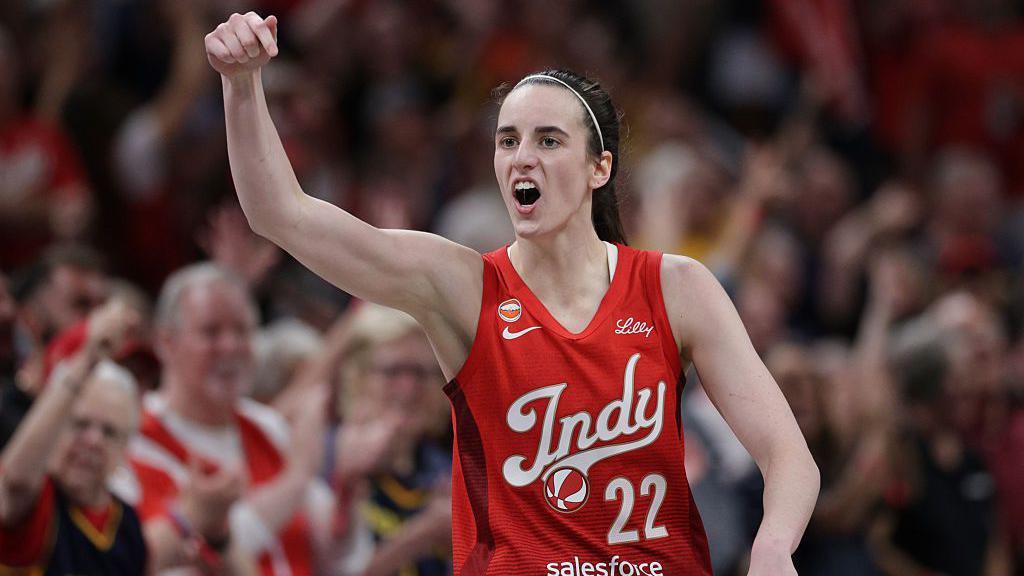
It is explosive material, perfectly designed for social media. It has a superstar, an unpopular coach, an apparent conspiracy, a public confrontation and a supposedly career-ending punishment from one of basketball’s most powerful executives.
It also does not withstand basic scrutiny.
There is no credible evidence that Silver fired or banned White. There is no verified recording of Clark delivering the extraordinary speech attributed to her. No reliable report confirms that White ordered Clark to stand in a corner while deliberately directing teammates to freeze her out. The supposed league statement condemning White for “sabotaging” the WNBA’s most valuable player cannot be found in any official announcement or reputable news report.
Most decisively, White was still coaching the Fever after the alleged lifetime ban. On September 29, she guided Indiana to a 99–89 playoff victory over the Las Vegas Aces, a result that forced a decisive Game 3. Clark produced 27 points, 15 assists and seven rebounds in that game, while White publicly praised her management of the offense.
The real Indiana Fever story is dramatic enough without inventing a basketball coup.
A Real Sideline Disagreement Becomes a Fictional Revolution
The viral account appears to begin with genuine frustration surrounding Indiana’s inconsistent defense and offensive execution. Clark has been visibly animated during games, and cameras have captured her speaking forcefully to members of the coaching staff.
In one widely discussed sequence, fans and online commentators attempted to interpret Clark’s words as a complaint about Indiana’s defensive rotations. The most common reading was that she wanted the Fever to rotate properly instead of leaving every defender to operate alone.
That interpretation may be plausible, but even an accurate reading would not establish a personal feud. Players and coaches frequently argue about coverages, spacing, transition decisions and missed assignments during games. Those conversations can look especially intense when a player is as competitive and expressive as Clark.
Earlier in the season, Clark and White publicly rejected claims that another animated sideline exchange revealed a deeper breakdown in their relationship. Clark described such confrontations as part of two competitive people trying to win, while White criticized the tendency to transform ordinary basketball tension into personal drama.
That history does not prove that every disagreement between them is harmless. It does, however, demonstrate why a short, silent video cannot support claims about hatred, insubordination or deliberate sabotage.
The viral story makes an enormous leap. A tactical disagreement becomes a “locker-room mutiny.” A frustrated gesture becomes evidence that Clark has rejected the coaching staff’s authority. Ordinary communication during a difficult game becomes a declaration that Clark now controls the franchise.
None of those conclusions is established by the available footage.
The Fabricated Speech
The most sensational part of the story is a lengthy quotation attributed to Clark. She is alleged to have ordered White to be quiet, accused her of ruining the franchise and announced that she would no longer run the coach’s plays.
That would be one of the most extraordinary public confrontations in modern professional basketball. If microphones had captured it clearly in a nationally televised game, the audio would have been replayed by every major sports outlet. Reporters would have questioned Clark, White, Indiana executives and league officials. The Fever would almost certainly have issued some form of response.
Instead, the quotation appears only inside sensational online narration. No original recording, official transcript or independent report verifies it.
The language is another warning sign. It sounds less like Clark’s documented public communication and more like the exaggerated voice of the narrator. Phrases about being “the undisputed god of this court,” saving the franchise and ordering a coach to sit down are constructed to produce outrage and excitement. They should not be presented as direct quotations without primary evidence.
Putting invented words into a public figure’s mouth is not analysis. It is fabrication.
Clark certainly plays with emotion. She argues calls, communicates loudly and demands accountability from herself and her teammates. Her intensity is one reason she has become such a compelling athlete. But intensity does not give content creators permission to manufacture dialogue on her behalf.
Adam Silver Did Not Permanently Ban Stephanie White
The story’s central claim—that Adam Silver personally fired White and banned her from the WNBA—is even easier to disprove.
First, no official statement supports it. Second, White continued coaching Indiana in the playoffs. Third, reputable coverage of the Fever’s postseason has treated her as the active head coach, discussing her rotations and adjustments rather than reporting a historic dismissal.
After Indiana lost Game 1 of its playoff series against Las Vegas, White addressed the team’s poor offensive execution, transition defense and costly turnovers. Clark gave Indiana’s performance an “F,” acknowledging both the defensive problems and her own six turnovers.
Two days later, White was still on the sideline as Indiana responded with its season-saving Game 2 victory.
That timeline alone destroys the alleged ban.
Silver has discussed Clark publicly. In July, he said that she had unfairly become a “political football” and addressed concerns about physical play, officiating and the hostile atmosphere surrounding the WNBA. His comments called for better standards and less toxicity; they did not announce a takeover of the Fever or a punishment against White.
The fabricated announcement also misunderstands how professional leagues and franchises operate. Even a powerful commissioner does not casually appear after a disagreement and permanently remove a team’s coach through an inflammatory public declaration. Such an action would involve the team, league governance, contracts and formal disciplinary procedures.
A lifetime ban would be major international sports news. It would not exist exclusively in a breathless viral monologue.
What Actually Happened Against Minnesota
The genuine game at the center of the story still offered plenty to discuss.
Indiana defeated Minnesota 96–77 on September 22, with Clark scoring 27 points and Kelsey Mitchell adding 20. The Fever controlled the early stages, finishing the first quarter with a 14–2 run and taking a commanding advantage into halftime.
Minnesota played without Olivia Miles, who was listed with a left calf injury. The Lynx’s later results allowed them to secure the No. 1 playoff seed, but Napheesa Collier still called the performance against Indiana embarrassing.
Those are legitimate basketball facts. They support an article about Clark’s performance, Minnesota’s lack of intensity, Indiana’s playoff positioning and the contrasting pressures facing both teams.
They do not prove that Clark played a personal psychological game against Miles. They do not show that Miles was smirking about Indiana’s coaching situation. They do not establish that Clark stared at her before launching a shot or that the two guards were engaged in a private battle for supremacy.
Those details are storytelling devices presented as observed reality.
There is a meaningful comparison to make between Clark and Miles. Both are gifted playmakers, and both influence games through pace, passing and court vision. Clark, however, carries a dramatically larger offensive and commercial burden. Comparing their games can produce worthwhile tactical analysis. Imagining hostile exchanges that cannot be verified contributes nothing.
Criticism of White Does Not Require a Conspiracy
Rejecting false claims does not mean White should be protected from basketball criticism.
Indiana has experienced legitimate problems involving defensive communication, lineup continuity and the distribution of minutes. At different points, the Fever have struggled to defend in transition, protect the paint and maintain coherent rotations. Fans are entitled to question why certain players receive extended opportunities while others disappear from the rotation.
The Fever’s Game 1 playoff loss to Las Vegas demonstrated those problems. The Aces scored 102 points, punished Indiana’s turnovers and received 38 points and 16 rebounds from A’ja Wilson. Clark recorded 15 points and 10 assists but also committed six turnovers. Indiana’s offense lacked consistency, while its defense failed to contain one of the league’s most powerful teams.
White deserves scrutiny for those failures. Her rotations can be evaluated. Her defensive schemes can be challenged. Analysts can ask whether Indiana is maximizing Clark’s transition passing and extraordinary shooting range. They can examine whether the team has enough size, whether its guards are overextended and whether its half-court offense becomes too predictable.
Those are serious questions rooted in observable basketball.
Accusing White of intentionally trying to destroy Clark is different. Deliberate sabotage requires evidence of intent. A poor rotation is not proof of jealousy. An unsuccessful play call is not proof that a coach wants to lose. A heated timeout does not establish psychological abuse.
The distinction matters because responsible criticism is stronger than conspiracy language. Saying that a coach made a bad decision invites tactical examination. Saying that she maliciously attacked her own superstar replaces analysis with an allegation that cannot be demonstrated.
Clark’s Actual Power Is More Impressive Than the Myth
The fictional version of Clark’s power is that she can openly rebel, destroy a coach’s career and summon intervention from Adam Silver.
Her real influence is more substantial.
Clark changes the geometry of a defense before she crosses half court. Her shooting range stretches coverage far beyond the three-point line. Her passing punishes traps and creates scoring opportunities for teammates. Her ability to accelerate in transition forces opponents to retreat before Indiana has fully established its offense.
That impact was visible in the Fever’s Game 2 win over Las Vegas. Clark responded to a technical foul by helping ignite a 16–4 run, repeatedly created shots for teammates and controlled important stretches of the fourth quarter. Even after she fouled out with 2:45 remaining, Mitchell and Aliyah Boston completed the victory with 26 and 22 points, respectively.
That game offered a far more convincing argument for Clark’s authority than any fictional speech. She did not need to tell the world she was saving the franchise. She demonstrated her value by creating offense against a championship-level opponent in an elimination game.
It also complicated the claim that White is determined to suppress her. A team does not accidentally produce 99 points while its lead guard finishes with 15 assists. Whatever legitimate disagreements exist about Indiana’s system, the Game 2 performance showed that Clark can thrive within it when execution, spacing and supporting production align.
Why These Stories Spread
The false narrative works because it attaches itself to genuine emotion.
Many Clark supporters believe the Fever have failed to build the ideal structure around her. Some distrust White’s coaching decisions. Others feel that Clark has faced unusually physical defense, inconsistent officiating and unfair media treatment. Those concerns create an audience ready to accept any story in which Clark finally fights back.
The content then escalates familiar frustrations into cinematic certainty. White is no longer a coach making questionable decisions; she becomes a villain deliberately committing sabotage. Clark is no longer a frustrated competitor; she becomes a revolutionary seizing control. Silver is no longer an executive discussing the league’s growth; he becomes an all-powerful judge issuing lifetime bans.
Each exaggeration increases the emotional payoff while moving further away from reality.
The result may attract clicks, but it damages the conversation around women’s basketball. It directs anger toward players and coaches over events that may never have happened. It encourages audiences to treat invented quotations as evidence. It also distracts from the tactical and organizational issues that deserve serious examination.
The Fever’s Real Test
Indiana does not need a fictional mutiny. Its real postseason challenge is already compelling.
The Fever must defend more consistently, reduce turnovers and keep the offense moving when opponents pressure Clark. White must establish dependable rotations and respond more quickly when a lineup is being exploited. Boston and Mitchell must continue producing enough offense to prevent opponents from loading every coverage toward Clark.
Clark’s responsibility is equally demanding. She must manage the emotional intensity of playoff basketball without losing efficiency, recognize when defenses are baiting her into difficult shots and continue balancing aggressive scoring with the playmaking that makes Indiana dangerous.
The Fever’s Game 2 response proved that they are capable of making those adjustments. It did not settle every question about White, the roster or the franchise’s long-term direction. It did establish that the season’s most important story is taking place on the court—not inside a fabricated press release.
Stephanie White has not been permanently banned. Caitlin Clark has not been verified telling her coach to shut up and sit down. Adam Silver has not taken control of the Fever, and no credible evidence shows that Indiana’s coaching staff has deliberately sabotaged its franchise player.
The truth is less theatrical but more meaningful: Clark is a transcendent guard trying to lead an imperfect team through the playoffs, White is a heavily scrutinized coach fighting to prove that her system can succeed, and every performance is being magnified by the enormous audience Clark brought to the league.
That is a genuine high-stakes basketball story. It does not need invented dialogue, imaginary bans or claims of a locker-room execution to matter.


