Chennedy Carter’s shoulder check on Caitlin Clark lasted only a moment, but the controversy surrounding it grew far beyond the contact itself.
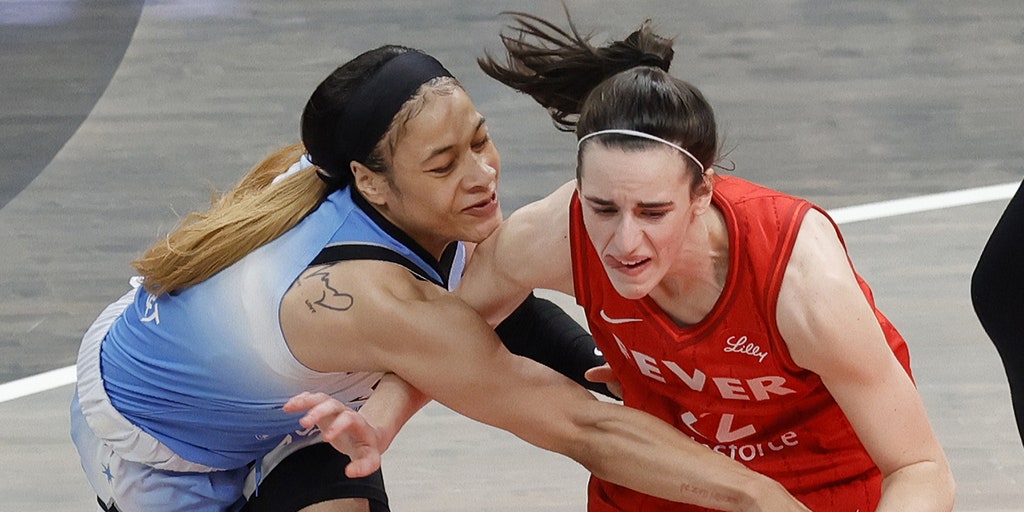
Clark was waiting for an inbound pass when Carter approached and knocked her to the floor. The ball was not being contested. There was no drive to stop, shot to challenge or loose ball between them.
Then the camera captured another detail: Angel Reese appeared to rise from Chicago’s bench and applaud.
That reaction transformed the incident. What might have remained a debate about one player losing control became a much larger argument about the Sky, Clark’s treatment inside the league and whether the officials had failed to recognize an obviously unnecessary act.
The confrontation occurred during Indiana’s June 1, 2024 home game against Chicago. It was the first professional meeting between Clark and Reese, whose college rivalry had already made every matchup between their teams feel bigger than an ordinary regular-season contest.
Indiana ultimately escaped with a 71–70 victory—its first home win of the season. Clark finished with 11 points, eight rebounds and six assists, while Reese recorded eight points and 13 rebounds.
The Carter incident unfolded near the end of the third quarter.

After scoring, Carter exchanged words with Clark. As play prepared to resume, Carter moved toward her and delivered a forceful shoulder check. Clark, who did not appear to be expecting the contact, fell to the court.
Officials assessed an away-from-the-ball common foul and did not review the play during the game.
That original decision became the first source of outrage. Physical defense is part of professional basketball, but this contact occurred during a stoppage and had no clear relationship to contesting possession. The absence of an immediate review left viewers wondering how such a visible collision could receive only the lowest available classification.
One day later, the WNBA reviewed the incident and upgraded Carter’s foul to a Flagrant 1.
The upgrade confirmed that the league considered the contact unnecessary. It also exposed the practical weakness of the original ruling: Clark received a free throw during a one-point game, but Chicago avoided the additional consequences that would have accompanied a flagrant decision made in real time.
There is still room to defend Carter without pretending the foul was ordinary.
Basketball is emotional, especially in a close game carrying unusual attention. Carter and Clark had been competing physically, and Carter had just completed a scoring play. Players sometimes react impulsively when frustration and adrenaline collide.
That explanation can account for the moment without proving that Carter planned to injure Clark or acted as part of an organized effort against her.
It does not, however, excuse the decision.
The strongest criticism is not that Carter played too aggressively. It is that she directed force at an opponent when the basketball was not involved. Whatever words had been exchanged, the response created contact that the league later determined met the Flagrant 1 standard.
Reese’s apparent applause made the scene more complicated.
Footage circulated showing her rise from the bench and clap after Carter knocked Clark down. That visual was widely interpreted as approval of the contact, although it cannot prove exactly what Reese understood or intended in those few seconds.
A teammate celebrating Carter’s competitive energy is one interpretation. A teammate celebrating an unnecessary hit is another. The camera captures the reaction but cannot read the motive behind it.
That distinction matters because the Clark-Reese storyline was already powerful enough to shape how viewers interpreted every interaction. Fans who believed Chicago resented Clark saw confirmation. Those who viewed the moment as ordinary team solidarity saw the controversy as an exaggerated reaction to intense basketball.
Chicago coach Teresa Weatherspoon later acknowledged that Carter had become caught up in the heat of the moment and said the behavior was not appropriate. Carter’s foul was formally upgraded, while Reese separately received a fine for failing to make herself available to the media after the game.
Clark’s response was noticeably restrained. She said she had not expected the contact but treated the situation as another challenge in a physical game. Rather than retaliating, she made the resulting free throw and continued playing.
That contrast helped create the lasting narrative: Carter delivered the hit, Reese appeared to celebrate, and Clark got back up.
But the most important lesson was about officiating. The league reached the stronger ruling only after the game was over. By then, the competitive consequences could not be restored.
The incident became more than a shoulder check because three images remained in conflict: Clark on the floor, Reese reacting on the bench and officials allowing play to continue without a review.
Part 2 would make the rivalry even harder to dismiss. This time, Reese would not be watching the contact from the sideline. She would be the player whose arm sent Clark back to the floor.


